
Anti-Pride Mobilizations as an Issue of Democratic Participation
Lea Bellmann (Dresden University of Technology, lea.bellmann@tu-dresden.de)
Dieser Beitrag ist hier auf Deutsch verfügbar.
On Saturday, July 25, 2026, an attack motivated by Islamist extremism took place at the Pride parade in Berlin. A man drove into a crowd, killing one woman and injuring 29 others – some of them severely. While queer communities and LGBTQIA+ advocacy groups1 have been organizing memorial events and support services, as well as demanding better protection for queer lives, the federal government, led by the conservative Christian Democratic Union (CDU), has focused on addressing the perpetrator. They propose introducing stricter policing and criminal laws to better prevent so-called ‘Gefährder’, individuals considered a security threat, from committing crimes.2
As an honest effort to prevent anti-queer violence and protect Pride marches, this narrow focus on Islamist extremism and terrorist attacks falls short. In recent years, it has primarily been far-right actors who have threatened Pride marches, registered counter-demonstrations, and carried out disruptive actions. During the 2024 Pride season, these anti-Pride mobilizations in Germany reached a new degree of size, visibility, and organization.3 In the 2025 season, a further increase was recorded: at least 110 of the 245 Pride marches nationwide were confronted with counter-protests or other disruptions.4 The eastern German state of Saxony emerged as a focal point in both seasons. It recorded the highest number of counter-demonstrations in the context of Pride events: in 2024, at least 17 of the 23 Pride events were affected, and in 2025, at least 12 of the 17 events were as well.5
It must be understood that attacks on local Pride marches and anti-Pride protests – including those in rural areas – are just the tip of the iceberg of globally rising queerphobia and increasing violence against LGBTQIA+ individuals. At the same time, they entail concrete consequences for queer people, Pride participants, and Pride organizers. This, in turn, implies greater challenges for democratic participation and queer visibility.
By presenting two selected findings from the brochure “Visibility and Security: The Impacts of Right-Wing Counter-Mobilizations on Pride Participants in Saxony,” this post aims to contribute to the debate on the security and protection of Pride parades and to raise questions that emerge from legal and social science perspectives. First of all, it must be stated that Islamist extremism and far-right extremism cannot be equated. Elsewhere, further work should be undertaken to contextualize both phenomena within broader frameworks of anti-feminism and queerphobia. Likewise, the security concepts at Berlin Pride, which draws hundreds of thousands of participants, can only be compared to a limited extent with rural, eastern German Pride events that sometimes have as few as a hundred attendees.
Visibility and Security: A Movement-Oriented Research Project
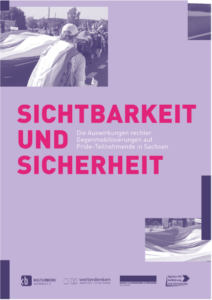
Our brochure is based on the analysis of an online survey of 2,701 Pride participants in Saxony during the 2025 season. This represents approximately 6 percent of all participants in Saxony and 16 percent of attendees at rural events. The findings provide initial insights into the impact of right-wing counter-mobilizations on the safety and empowerment of Pride participants. The term ‘right-wing counter-mobilizations’ encompasses both registered counter-demonstrations and spontaneous disruptions by individuals. The use of ‘right-wing’ rather than ‘far-right’ illustrates that the attacks do not originate solely from individuals within the organized far-right, but extend into a right-conservative milieu.
Following the approach of a movement-oriented research project, we did not primarily publish these findings in academic articles, but rather first in a freely accessible brochure. Furthermore, Pride organizers were involved in the design of the project.
The study reveals numerous infringements on the safety of Pride participants: almost 40 percent of respondents indicated feeling rather or very unsafe on their way home; insults and threats were experienced at all events; a total of 55 cases of personally experienced physical violence were reported; and participants report, for example, restricting their choice of outfit in order to avoid being recognized. The analysis also highlights concrete factors contributing to this insecurity, and thereby also opportunities to improve safety. I present two of these findings below.
“Counter-Protests within Sight and Sound”: Proximity as a Safety Factor
When asked what would increase safety at Saxon Prides, respondents raised two primary demands: a ban on counter-demonstrations and the far-right organizations behind them, as well as the greatest possible distance between the Pride march and the counter-demonstration:
“No authorization of right-wing demos ‘within hearing and sight,’ especially no ‘walking behind the parade’—that constitutes a concrete threat!” (Participant at Dresden Pride, author’s translation)
“[…] If the Nazis weren’t allowed to demonstrate at the same time. But that is a delicate matter in a democratic state and could potentially also prevent demos against right-wing thugs.” (Participant at Bautzen Pride, author’s translation)
The potential for distance to be a central factor in increasing safety is evident not only in the respondents’ demands, but also in their sense of security. As the following example illustrates, it is not the size of the counter-protest that is pivotal, but rather the proximity of the disruptive individuals. Months in advance, neo-Nazi and far-right structures mobilized against the Pride parade in Bautzen. In 2025, just as in 2024, the Bautzen Pride parade faced the largest anti-queer counter-demonstration in Germany. Despite the 550 counter-demonstrators, 9 out of 10 Pride participants felt rather or very safe during the event. This was because, by means of additional registered assemblies in side streets and between the Pride march and the counter-demonstration, it was possible to keep the counter-protesters out of earshot and sight for most of the event.
In contrast, the sense of safety was lowest at the Pride march in Plauen. 22 percent of respondents felt rather or very unsafe during the event. In their open-ended responses for the survey, participants repeatedly described the right-wing youths as having violated the Pride parade as a ‘safe space’:
“The fact that neo-Nazis were able to repeatedly cross the event square, insult people, utter threats, and display far-right symbols with impunity… unsettled me. I would have liked to see some consequence from the police, at least an intervention and an order to leave the square.” (Participant at Plauen Pride, author’s translation)
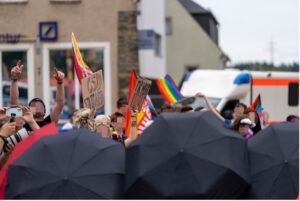
Proximity also carries the risk of being recognized. Local Pride participants in particular report seeing acquaintances or schoolmates taking part in counter-demonstrations. The worry of having been recognized or even photographed at the Pride march leads to feelings of insecurity persisting long after the day of the event. Participants can never be certain whether or not violence will follow later. Slogans like “We’ll get you all” and graffiti at train stations with phrases such as “Hunt leftists” (‘Zecken jagen’) or “Kill trans people” (‘Transen töten’) illustrate the violent fantasies of the demonstrators.
“Freedom of the Press”: Far-Right Streamers and Photographers at Prides
In addition to concerns of being photographed and filmed by far-right private individuals, participants also fear being exposed by far-right photographers and streamers with a much greater reach:
“For my part, there was primarily the concern that far-right journalists or photographers could take pictures of me to track me down, and that physical attacks might only manifest in the aftermath, for example through stalking. Due to violent calls like ‘We’ll get you all’ from the right-wing opposing forces, my fear of being subjected to physical attacks intensified.” (Participant at Bautzen Pride, author’s translation)
“The police allowed a far-right streamer to follow the demo and film the whole thing live. We tried to protect ourselves with umbrellas and banners to avoid ending up with our faces on this far-right channel. Instead of removing the streamer/keeping them away from the demo, the police informed us that we were not allowed to hinder this person’s ‘journalistic’ work. […]” (Participant at Pirna Pride, author’s translation)
These far-right streamers are a new phenomenon. Often equipped with supposed press passes, they walk through the Pride marches and try to engage people in conversation. Their questions are one-sided and aim to ridicule queer and left-wing positions. The streams show Pride participants without anonymization, exposing them to tens of thousands of hostile viewers. The comment sections are full of hate, up to and including death threats. Often, there are hardly any opportunities to evade being recorded.
So far, there is no uniform police strategy for dealing with streamers. While there have been individual cases of streamers being expelled from assemblies, it also regularly happens that their presence is facilitated by the police. In isolated cases, Pride participants who tried to shield themselves against far-right streamers were even subjected to identity checks.
The Bigger Picture: Impacts on Freedom of Assembly?
Not all impacts of the right-wing counter-mobilizations can be made visible through surveys of Pride participants. For instance, there are individuals who no longer attend Saxon Prides out of fear of violence. The size of this group remains unclear. However, our survey of Pride participants shows that a total of 36 percent of respondents know at least one person who did not attend an event out of fear. At events with counter-demonstrations, this share stands at 43 percent, which is 7 percentage points higher than the overall sample; at rural Pride marches, it reaches 46 percent, exceeding the overall sample by 10 percentage points. The demographics of those who no longer participate out of fear are largely unclear. However, respondents report that they did not bring their children, or that people of color from their social circles did not participate because they feel particularly unsafe. In addition to the Pride participants themselves, it is primarily the organizers who report ever-increasing hurdles in organizing Pride parades. These range from immense organizational burdens and rising costs for security measures to year-round hostilities in everyday life.
Viewing these results as a whole, larger questions regarding democratic participation arise. What are the consequences when individuals no longer dare to exercise their right of assembly and their right to freedom of expression? How is trust in democratic institutions impaired when participants no longer feel protected by the police? And what happens when the right of assembly for one group becomes a danger to another?
While the past two seasons saw numerous right-wing counter-demonstrations at Pride parades, their number has decreased in 2026. Instead, however, we suspect a shift towards outright violence: there have been incidents of eggs being thrown from residential buildings, physical assaults by passersby, and insults on the way home. The counter-demonstrations have often disappeared, but the violence has remained. The question of counter-strategies and protection therefore remains urgent, and the government’s response must not remain solely focused on the perpetrators.
The complete brochure and the data report are available in German and can be accessed here: https://kulturbuero-sachsen.de/neue-broschuere-sichtbarkeit-und-sicherheit/
- LGBTQIA+ stands for lesbian, gay, bisexual, trans, queer, intersex, and asexual people. The plus sign encompasses further identities beyond these categories. In the text, the terms LGBTQIA+ and queer are used synonymously to improve readability. Both refer to all individuals who position themselves outside the cis-hetero-binary spectrum. ↩︎
- Antonette Stephany and Björn-Hendrik Otte, Was sagt das Gesetz zu Dobrindts Forderungen? (Tagesschau 2026) <https://www.tagesschau.de/inland/innenpolitik/csd-anschlag-forderungen-recht-100.html> accessed 1 August 2026. ↩︎
- Jessa Mellea and Joe Düker, Eine neue Generation von Neonazis: Mobilisierungen gegen CSD-Veranstaltungen im Jahr 2024 durch rechtsextreme Jugendgruppen im Internet (CeMAS 2024) <https://cemas.io/publikationen/neue-generation-neonazis-mobilisierung-gegen-csd-veranstaltungen> accessed 1 August 2026. ↩︎
- Lea Lochau and Ronja Pohl, Queerfeindlichkeit sichtbar machen: Sicherheitsreport zu rechtsextremen Angriffen auf CSDs (Amadeu Antonio Stiftung 2025) <https://www.amadeu-antonio-stiftung.de/wp-content/uploads/2025/10/Amadeu-Antonio-Stiftung_Sicherheitsreport-2025.pdf> accessed 1 August 2026;
Joe Düker, Jessa Mellea and David Faßbender, Keine Entwarnung: Rechtsextreme Anti-CSD Aufmärsche zwischen Fragmentierung und Kontinuität (CeMAS 2025) <https://cemas.io/publikationen/keine-entwarnung> accessed 1 August 2026. ↩︎ - Jessa Mellea and Joe Düker, Eine neue Generation von Neonazis: Mobilisierungen gegen CSD-Veranstaltungen im Jahr 2024 durch rechtsextreme Jugendgruppen im Internet (CeMAS 2024) <https://cemas.io/publikationen/neue-generation-neonazis-mobilisierung-gegen-csd-veranstaltungen> accessed 1 August 2026. ↩︎